4 June 2026 | Kisaambo Cell, Kisaambo Ward, Kizirafumbi Sub-county, Kikuube District
Residents attend the community health camp in Kisaambo Ward, Kikuube District.
Women from Kisaambo and neighbouring areas accessed free health services during a one-day community health camp jointly organised by Citizens’ Concern Africa and Vijana for Sustainable Development and Environmental Action under their climate and health work in Uganda’s oilhost communities.
The activity focused on women who are Project-Affected Persons, commonly referred to as PAPs, and other residents living near oil developments. It brought health workers closer to women who may face long travel distances, transport costs and limited opportunities for routine screening.
Part of a wider three district programme
The health camp formed part of the Empowering Women for Resilience against Climate Change Health Impacts in Oil-Host Communities project, which covers Hoima, Buliisa and Kikuube districts. The Kisaambo camp was hosted in Kikuube under the Locally Led Action for Safer Climate and Stronger Health in Oil-Affected Communities initiative.
The programme recognises that women living in areas experiencing oil development are managing several pressures at the same time, including environmental change, changing livelihoods and unequal access to essential services. Women who are Project-Affected Persons may face additional barriers to healthcare, reliable water, food security and household income.
Climate-related pressures can increase exposure to extreme heat, unsafe or unreliable water, malaria and other illnesses, food insecurity and poor nutrition. These risks can place an additional burden on women, who often care for children, older people and sick family members while also supporting household livelihoods. Bringing preventive and basic health services closer to them is therefore an important part of building resilience.
A wider climate health response
The community health camp was one part of a broader response designed to improve health, preparedness and livelihoods among women and vulnerable households in oil-project-affected areas. Across the programme, CICOA and VIDEA are working with local institutions and community structures in the oil-host districts to combine immediate health support with longer-term resilience.
The wider initiative includes:
- community health screening and education on climate-related health risks
- training for health workers and Village Health Teams to strengthen community-level prevention and response
- promotion of sanitation, hygiene and preventive health practices
- planting 20,000 trees to support environmental restoration and climate resilience
- establishing and equipping five Women Resource Centres where women can access information, organise and receive support
- business and financial literacy training to help women strengthen household livelihoods
- community disaster preparedness and early-warning activities to help households anticipate and respond to climate-related emergencies
Health services provided
Health workers from Kikuube Health Centre IV provided:
- general medical consultations
- HIV testing and counselling
- malaria testing and treatment
- blood sugar and blood pressure screening
- urinary tract infection testing
- health education, medical advice and treatment for diagnosed conditions
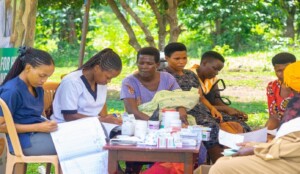
Residents receive treatment and medical advice from health workers during the Kisaambo outreach.
The camp also enabled residents to ask questions about their health and seek attention for conditions they may not have known they had.
Providing several services at one location reduced the need for women to make separate journeys for basic checks. The outreach also created space for participants to discuss symptoms, receive counselling where required and obtain guidance from trained health workers.
Why community outreach matters
Dr Collin Kaboyo, who led the health team from Kikuube Health Centre IV, said taking services closer to residents is especially important for people affected by distance and the cost of reaching health facilities.
“Early diagnosis and treatment can help prevent complications and improve people’s health.”
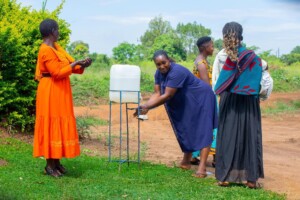
Participants practice proper hand-washing during a health education session.
VIDEA partnership for health and resilience
The activity was implemented by Vijana for Sustainable Development and Environmental Action (VIDEA) and Citizens’ Concern Africa (CICOA), with support from Foundation S, the Sanofi Collective. It was carried out in collaboration with Kikuube District Local Government, Kikuube Health Centre IV and the EACOP Host Communities Project.
For VIDEA, the outreach connected its work on women’s rights, climate action and community health. The activity placed women’s experiences at the centre and combined direct service delivery with health education and practical environmental action.
Andrew Mafundo, Executive Director of CICOA, said the programme combines access to health services with environmental action to strengthen the resilience of communities affected by oil development.
Ashley Katumwesigye, Senior Communications and Programmes Officer for the EACOP Host Communities Project, said collaboration among community organisations, local government and health workers is important to improving wellbeing in the area.
A resident calls for regular outreaches
Ainembabazi Jennifer, a resident of Kisaambo Ward, welcomed the opportunity to access several health services in one place. She encouraged the partners to organise regular outreaches because many residents do not routinely receive comprehensive health screening.
Health and environmental action
Alongside the health services, indigenous tree seedlings were distributed to households to support environmental conservation and help residents respond to climate-related challenges.
The tree distribution reinforced the connection between environmental conditions and human health. Trees can contribute to shade, soil protection and healthier local environments, while community discussions helped participants understand why climate resilience and health protection need to be addressed together.
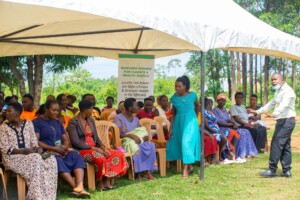
Women and other residents take part in a community health education session during the camp.
The Kikuube outreach forms part of VIDEA’s wider effort to ensure that women affected by oil projects are not left behind in responses to climate change and public health challenges. Similar work across Hoima, Buliisa and Kikuube seeks to strengthen women’s access to information, services and practical support, while raising attention to the particular pressures they face in oil-host communities.
About VIDEA
Vijana for Sustainable Development and Environmental Action is a youth- and women-led organisation advancing women’s leadership, sustainable livelihoods, sexual and reproductive health and rights, climate action and digital inclusion. VIDEA works with local organisations, public institutions and communities to develop practical responses shaped by the experiences of women and young people.